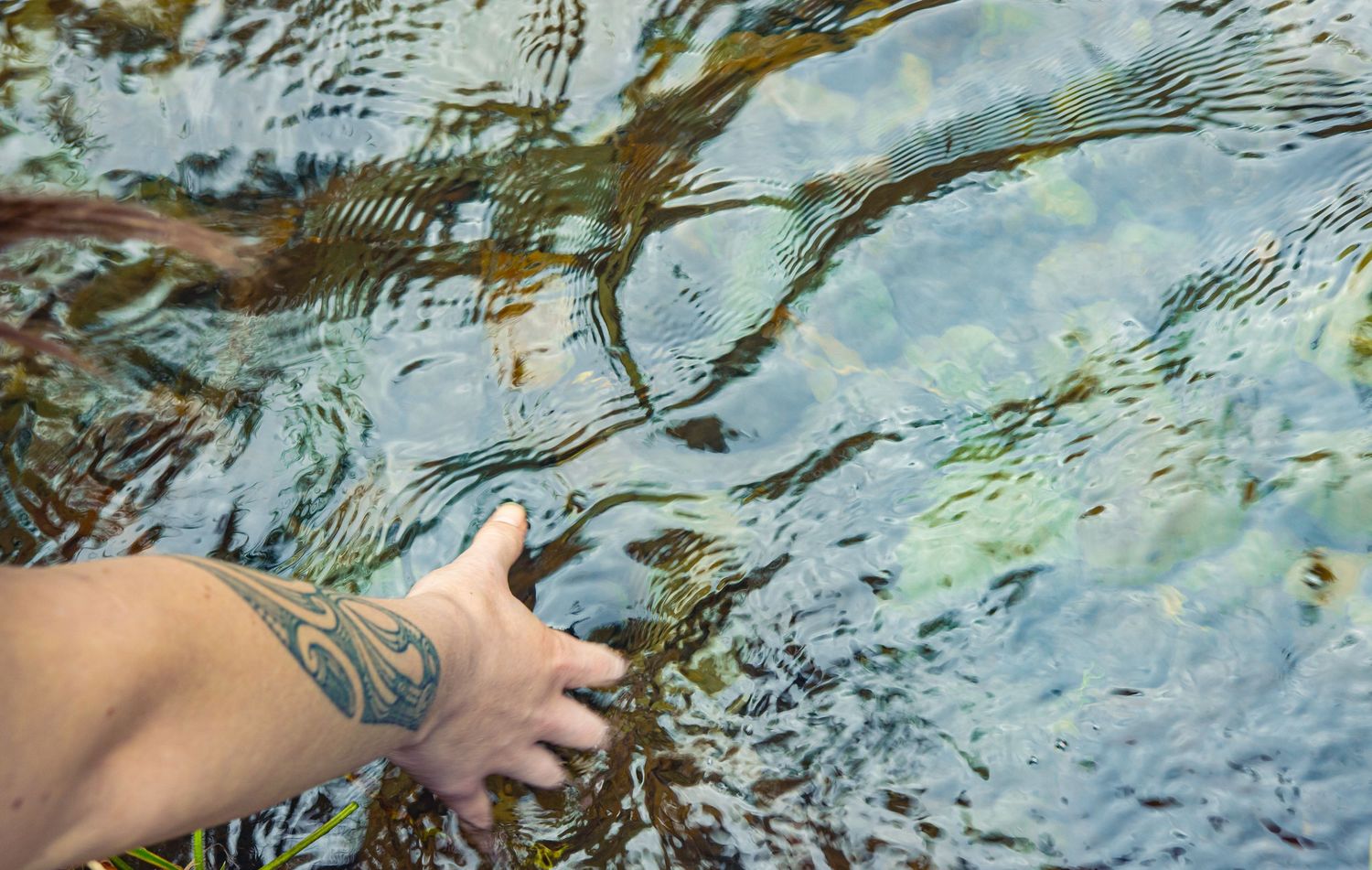
On Saturday, I visited art studios with my friend Ila Rose in Raglan, and I couldn’t help but think about how beyond the coastal shoreline, consciousness itself continues, how the sea must sing its own kind of creation, how the fish might feel what I feel when I enter a studio. There was salt in the breathe that morning, and as we stepped through portals of paint and clay, I thought of coral breathing, of reefs murmuring colour through water, of life clustering around texture and tone. The studios, like reefs, were not just shelters; they were sanctuaries of becoming.
Each artist we met was a creature of their own tide. One brushed light across canvas as if feeding on the plankton of memory, another sculpted forms that glowed with inner phosphorescence. As I watched Ila drift through it all, curious and gentle, moving between spaces, I realised we were both swimming, not walking. The walls felt porous, the air viscous like water, and I could almost feel the pulse of creation beneath everything, deep and eternal, like the breathing of the sea.
The reef, I imagined, is a living gallery. Fish move between coral towers the way we move between easels and tables, each species shaped by the cadence of its habitat, each gesture a conversation with the environment that made it. We humans think ourselves separate from that symphony, yet in studios we return to it, silently and instinctively. We find our coral. We anchor ourselves to beauty and survival alike. The artist’s brush is a fin, the camera a shell, the hand a current, the body a tide.
In a reef, no creature thrives alone. Each one belongs to an ecosystem of exchange, algae feeding coral, coral sheltering fish, fish scattering nutrients that sustain the reef’s breath. The same current runs through an art community. Pigments mix. Words feed images. Clay listens to hands. Light bends itself around stories. There is no isolation in true creation. The more we give, the brighter the reef glows, the more we share, the deeper the studio breathes.
I thought of the way light filters through water, fractured and shimmering, never still. That is the way inspiration feels, caught in fragments, refracted through doubt and joy. Artists are like sea creatures who have learned to navigate these unpredictable beams. Some dart fast, seeking the flash of the moment, while others linger in shadow, knowing that certain colours can only exist in dimness. Both are vital. Both sustain the whole.
There is something special about that mutual survival. A reef is tender, vulnerable to the fever of greed and pollution, yet endlessly regenerative when respected. So too are our creative spaces. They bloom in trust and wither in competition. They are held together not by walls but by attention, the delicate and devoted kind. To enter a studio is to kneel before a living organism, to breathe with it, to hear its secret stirring beneath the noise of the world.
Sometimes, when I write or photograph alone, I feel like a lone fish separated from its reef, adrift and searching for that frequency. But then I remember mornings like that one in Raglan, Ila’s giggle mingling with the scent of turpentine, the gentle resonance of conversation, the windows filled with light. And I realise the reef is never gone; it simply changes shape. It exists in every shared glance, every brushstroke, every act of noticing.
Perhaps this is what the sea knows that we forget. Community is not a place but a living tide that carries us back to ourselves. The reef does not ask to be admired; it simply exists, radiant and fragile, holding life within its arms. The studio, too, does not demand reverence. It waits, breathing softly, for those who remember how to listen. And when we do, we find that creation itself is the ocean, vast, sentient, and alive, and we are all just small, luminous fish, forever returning home.